© Merle Harton, Jr. | About | XML/RSS 
Monday, October 09, 2006
FAIRness at PBSI suppose it's very easy to gauge the heavy corporate sponsorship of the PBS NewsHour with Jim Lehrer, but this latest relevation about its imbalance in reporting will surprise you. At least it did me.
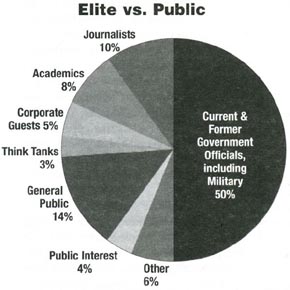
In 1990 Fairness & Accuracy In Reporting found that the PBS program NewsHour presented "an even narrower segment of the political spectrum" than, by comparison, ABC's Nightline. In a new examination of balance and objectivity at PBS, the news watchdog has discovered, after 16 years, that not a whole heck of a lot has changed: FAIR's latest study examined the program's guestlist over a six-month period spanning October 2005 through March 2006. The study recorded every on-air source appearing on the show, including live and taped guests. Groups that generally enjoy exceptional access to public communications were particularly privileged on the NewsHour, with five elite occupations dominating the list in number of appearances. Current and former government officials, including military officials, led all categories, accounting for 50 percent of total guests. Journalists amounted to 10 percent, with academics at 8 percent, corporate guests at 5 percent and think tank experts accounting for 3 percent. These five occupations totaled 1,845 sources, or 76 percent of the program's total. 1Among the other findings:2 FAIR chart showing the percentage of participation on the PBS NewsHour with Jim Lehrer. Public interest groups accounted for just 4 percent of total sources. General public—"person in the street," workers, students—accounted for only 14 percent, while current and former government and military officials totaled 50 percent of all sources. Male sources outnumbered women by more than 4-to-1 (82 percent to 18 percent). Moreover, 72 percent of US guests were white males, while just 6 percent were women of color. People of color made up only 15 percent of US sources. African-Americans made up 9 percent, Latinos 2 percent, and Asian-Americans and people of Mideastern descent made up one percent each. Alberto Gonzales accounted for more than 30 percent of Latino sources, while Condoleeza Rice accounted for nearly 13 percent of African-American sources. Among partisan sources, Republicans outnumbered Democrats on the NewsHour by 2-to-1 (66 percent vs 33 percent). Only one representative of a third party appeared during the study period. At a time when a large proportion of the US public already favored withdrawal from Iraq, "stay the course" sources outnumbered pro-withdrawal sources more than 5-to-1. In the entire six months studied, not a single peace activist was heard on the NewsHour on the subject of Iraq. Segments on Hurricane Katrina accounted for less than 10 percent of all sources, but provided nearly half (46 percent) of all African-American sources during the study period. Those African-Americans were largely presented as victims rather than leaders or experts: In segments on the human impact of the storm, African-Americans made up 51 percent of sources, but in reconstruction segments, whites dominated with 72 percent of sources; 59 percent of all African-American sources across Katrina segments were general public sources.
Their conclusion is therefore that "The findings confirmed the results of FAIR's 1990 study of the NewsHour, which found that the PBS news program offered less diversity than ABC's Nightline." They recommend that we contact PBS and expressing our displeasure at the imbalance. I did. I composed my comments to PBS Ombudsman Michael Getler at www.pbs.org/ombudsman/feedback.html.
1. See the full report at "Are You on the NewsHour's Guestlist?" - Fairness & Accuracy in Reporting, September/October 2006.
2. I'm pulling these bulleted items straight from FAIR's Action Alert.
Related Tags: FAIR, NewsHour, Nightline, PBS
posted by Merle Harton Jr. |
1:30 PM |

|