weblog | newquaker.com
|
|
| notebook weblog | newquaker.com |
|
© Merle Harton, Jr. | About | XML/RSS
Sunday, February 17, 2008
Christianism and Some of Its Pestilent DroppingsWho would have thought that usury would be more prevalent in Christian communities? The thought should come easier, somewhat like a greased banana, if you replace "Christian" with "christianist." We're not talking about plain-vanilla usury here, but predatory lending to the tune of APR rates as high as 570% (or even rates with no limits in Idaho and Utah). Forget about loan sharks, this is the new payday loan industry. We conclude with a high degree of statistical certainty that states with powerful conservative Christian populations tend to host relatively greater numbers of payday loan locations per capita as well as a greater commercial density of payday lenders. These findings propound a tragic and sad irony. Those states that have most ardently held to their pious Christian traditions have tended to become more infested with the progeny of money changers once expelled by Christ from the Hebrew temple. Legislators in those states who have effectively used Biblical principles to shape their legislative agenda on social and cultural issues have failed to consistently apply Biblical principles to economic legislation. The "strong correlation between the density of payday lending industry and the political power of conservative Christians" certainly suggests that conservative Christian communities are letting this happen, and may even approve of it. Equally interesting is their methodology in getting to a measure of the political power of Conservative Christian Americans. Recognizing the difficulty in calculating "the power of Christian values in the legislative process," the authors come up with a useful proxy they call "Christian Power Index" or CPI. They generate this CPI by ranking states according to these three variables: • Per capita density of Evangelical Christians and Mormons (to "rank states based on the simple percentage of people whom we believe are prone use their Christian faith to guide them as they vote for public officials") • A Christian Political Organization score (built predominantly by using "voter scorecards" published by Project Vote Smart for "three prominent Christian political action organizations: The Christian Coalition, the Family Research Council and the Christian Action Network") • An average statewide Congressional delegation voting record on social/cultural issues While this goes a long way toward measuring the "christianist" category and giving substance to the socio-political influence of this conservative group, it is worth noting that, in the process of building their rubric, they leave Roman Catholics fully outside of the "Christian Right" category, and this even serves to offset the scoring in their first variable.2 Clearly their CPI encompasses only Protestant denominations. 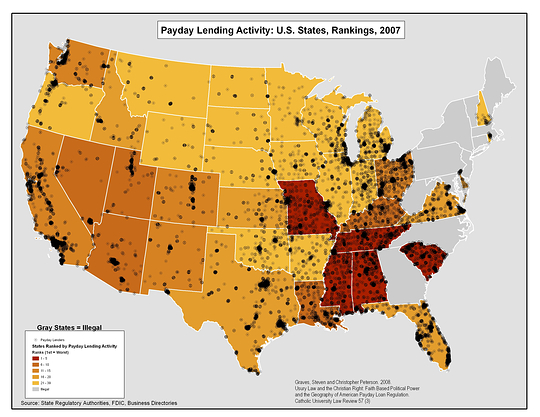 Their picture of the payday loan industry, congested in these heavily christianist regions, has much in common, I think, with a recent map of the impact of humans on the world's oceans. This composite map, drawn by a team of scientists led by Ben Halpern of the National Center for Ecological Analysis and Synthesis in Santa Barbara, CA, tells their story from a very different frame of reference:4 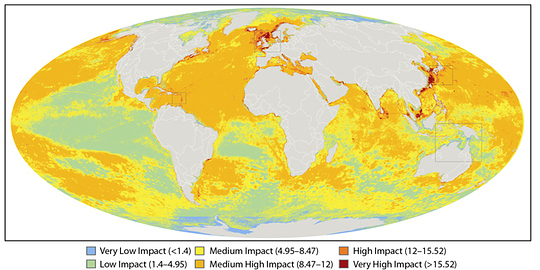 1. See "U of U Professor Coauthors Study Mapping Correlation Between Christian Right, Payday Lenders," University of Utah S.J. Quinney College of Law News, February 11, 2008. See also "Usury Study Says Payday Lenders More Prevalent In Areas Of High Christian Conservative Power," The Consumerist, February 17, 2008. Labels: Christianism posted by Merle Harton Jr. | 9:45 PM |
|
|
|
|
|
||||||||||||||||||||
|
 |
|||||||||||||||||||||||
|
||||||||||||||||||||||||